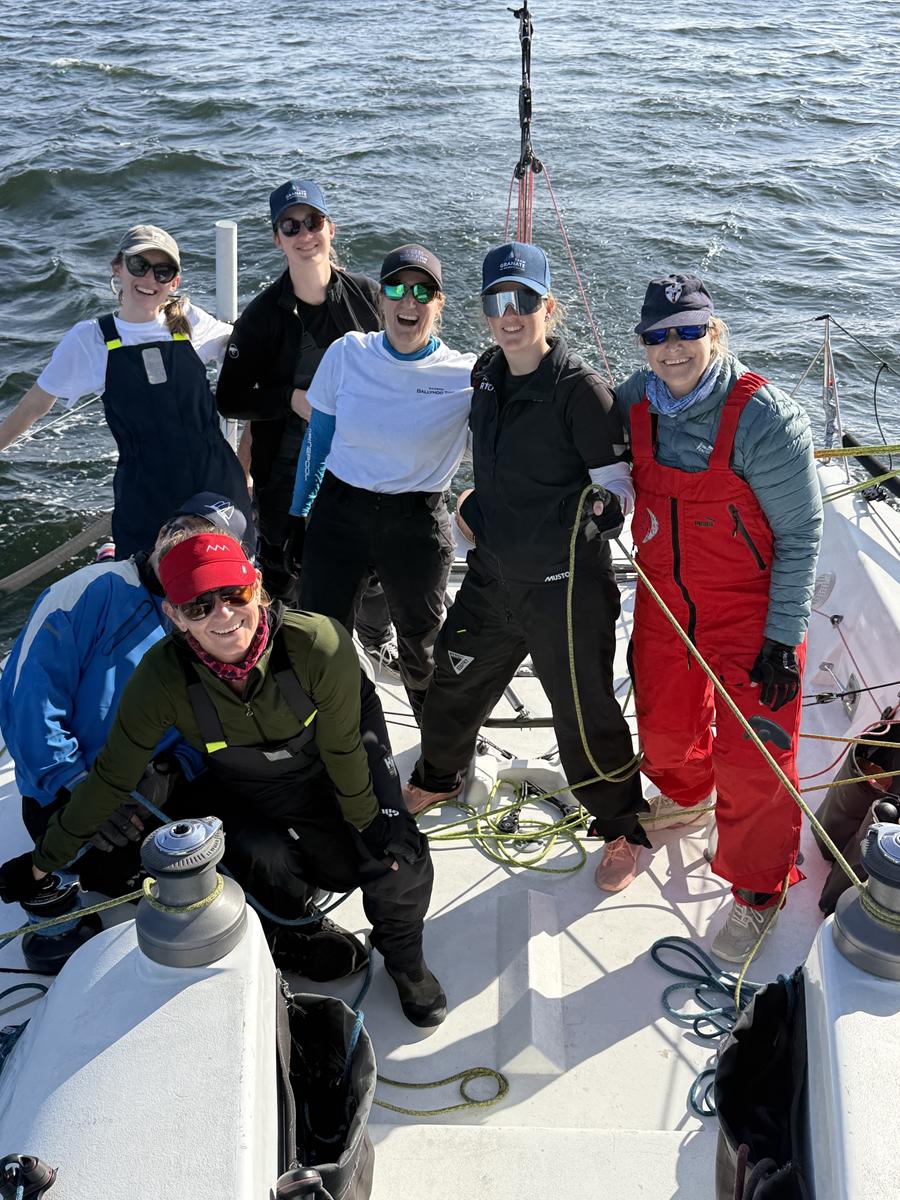
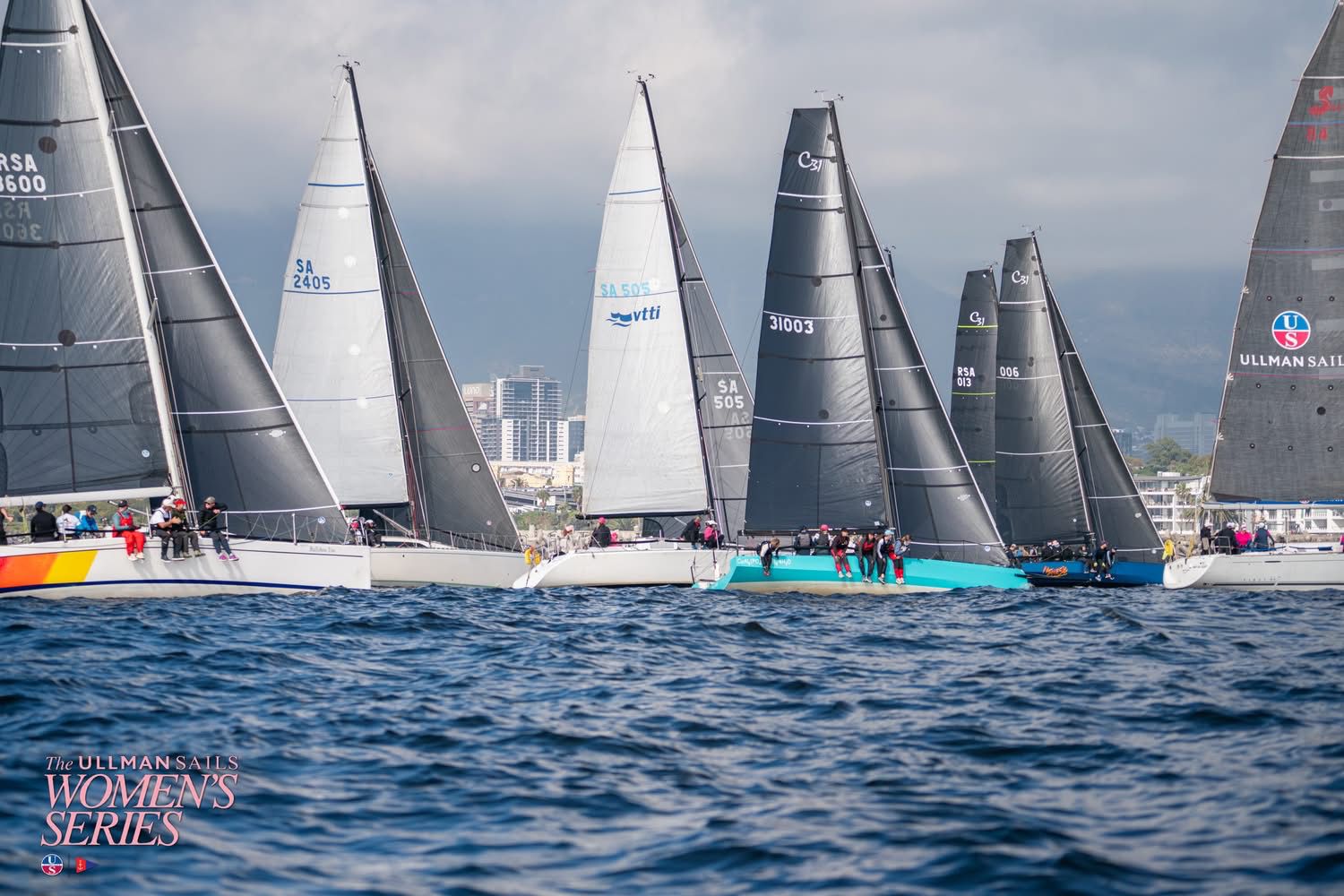
It was a pleasure, as it always is, to sail with a wonderful group of women in the first race of the 2026 Ullman Sails South Africa Women’s Series at Royal Cape Yacht Club.
I joined our crew on the Mumm 36 Ballyhoo Too for an afternoon of Cape Town autumn sailing at its best. There was enough wind to remind us that this was a yacht race and not a gentle cruise around Table Bay, but also enough sunshine and good humour to make it one of those afternoons that reminds me why I keep returning to sailing, even when life repeatedly finds ways of getting in the way. Beautiful autumn and winter days in Cape Town definitely make for the best sailing days!
The 2026 Ullman Sails Women’s Series includes two race days and a Women’s Cruise, bringing women from across Cape Town’s sailing community together on the water. It is competitive, but there is also a spirit around women’s sailing events that is difficult to describe unless you have experienced one.
There is a great deal of laughter. There are usually several opinions on how something should be done, all expressed with complete confidence. There is encouragement, and an ability to move on very quickly when something has not gone entirely according to plan.
In other words, it is yacht racing, but with a particularly enjoyable energy.
Growing up with the sea
Sailing has been part of my life for as long as I can remember.
My parents taught my sister and me that many of the best things in life are free, or close to it. Our weekends were not generally spent eating in restaurants or being entertained somewhere expensive. In summer, we went to the beach and swam in the sea. In winter, we walked in the mountains and forests, or took long walks along the beach when the weather allowed.
That may sound idyllic, and in many ways it was, but I am also very conscious that it was a privilege. Even in Cape Town, where the mountain and ocean are visible from so many parts of the city, not everyone has easy or affordable access to beaches, forests, safe walking routes or sailing. Being close enough to reach those places, having parents with the time and means to take us there, and growing up feeling comfortable in nature were all privileges I probably did not fully appreciate as a child.
We had a fairly humble upbringing in many respects, but we were enormously privileged in others. We had the sea, the mountains and parents who understood their value.
My father spent years building a little 24-foot wooden boat, and it was on that boat that he taught my sister and me to sail. Anyone who has built a wooden boat will understand that “spent years building” is not a figure of speech. A wooden boat can absorb almost unlimited quantities of time, money, patience and sandpaper, while still looking as though it requires just one more small job.
Nevertheless, she eventually sailed, and we sailed with her.
The sea became embedded in my life and, I think, in my psyche. As I wrote in another article, the ocean does not need an immediate reply. Long before emails and mobile phones made us available at all hours, I had already learnt that being near the sea changed my perspective.
Losing sailing and finding it again
When I moved to London and lived there for three years, one of the things I missed most was simply being able to see the sea.
I was fortunate to spend some of that time living near the southern end of Richmond Park, where I could walk and see the deer and find a little space away from the city. It was beautiful, but it was not the sea. London has many extraordinary qualities, but the ability to put one’s feet in the Atlantic after a bad week is not among them.
During those years, and for some time afterwards, I hardly sailed at all. I sailed a little while I was at university, but then work took over, as it has a habit of doing.
When I started working, there was considerably less conversation about work-life balance than there is today. Working until seven or eight in the evening was entirely normal, and working over weekends was not treated as a warning sign that one needed stronger boundaries and a wellness app. It was simply work.
I spent years in the motor industry, where showrooms were often open seven days a week. Sailing, unfortunately, is not a sport that slips neatly into a spare 45 minutes between work and supper.
Eventually, a colleague encouraged me back onto the water. Within about a year, I had completed my skipper’s certificate and become thoroughly involved again. As often happens with me, I did not restrict that involvement to going sailing occasionally and having a pleasant afternoon. I joined yacht club committees, became involved in administration and marketing, and donated what must amount to months of my life to sailing organisations and projects.
My husband and I also founded and ran the South African sailing portal GybeSet for many years. In racing, a gybe set is a manoeuvre in which a boat rounds the windward mark, gybes and sets the spinnaker to head down the opposite side of the course. Done well, it is quick and tactically clever. Done badly, it can produce an impressive amount of rope, sailcloth and shouting in a very small space.
It therefore seemed an entirely suitable name for a sailing website.
Women have always been there
Women’s sailing events matter partly because women have been sailing, racing and crossing oceans for far longer than the visibility they received might suggest.
Internationally, women such as Isabelle Autissier, Tracy Edwards, Ellen MacArthur and Dee Caffari changed perceptions of what women could achieve at sea. Autissier became the first woman to complete a solo round-the-world race in competition. Tracy Edwards and the crew of Maiden became the first all-female crew to compete in the Whitbread Round the World Race in 1989.
South Africa has its own important history. In the first Cape to Rio Race in 1971, Molly Warr skippered Sprinter with an all-female crew, the first South African women’s crew to compete in an ocean race between two continents. Many incredible woman sailors later skippered all-female crews in subsequent transatlantic races.
More recently, Dominique Provoyeur represented South Africa at the Olympic Games, while Kirsten Neuschäfer made international history by winning the 2022 Golden Globe Race. She became the first woman to win a round-the-world yacht race by way of the three great capes and the first South African sailor to win a round-the-world event.
Vuyisile Jaca’s story is equally important. After discovering sailing through Sail Africa, she went on to race around the world aboard Maiden. The all-female crew won the 2023 – 2024 Ocean Globe Race, while Jaca was also among the first Black women to race around Cape Horn.
These are exceptional achievements, but they began in the same way most sailing careers begin. Someone created an opportunity. Someone invited a woman onto a boat, handed her a sheet or the wheel, trusted her with a real job and allowed her to build experience.
The cumulative experience women lose
I have always been fairly realistic about the fact that we live in a society where women still carry a disproportionate share of parenting and family responsibilities.
Sailing makes this particularly visible because it is a very time-hungry sport. One cannot put on a pair of running shoes, run five kilometres and be home half an hour later. Even an ordinary club race can mean leaving home early in the morning and returning after sunset. A regatta can take three or four full days, before one has included boat preparation, deliveries and the inevitable time spent standing around waiting for the wind to arrive or calm down.
When women have children, their sailing often becomes curtailed. This is not true for every family and every woman, but it happens often enough to affect the cumulative experience women are able to build. Men become fathers and frequently continue sailing with much the same regularity. Women become mothers and are more likely to be the person making sure there is childcare, food, homework, transport and some functioning order at home before disappearing for an entire day.
This is not a woe-is-me observation. It is simply one of the practical reasons women may have fewer sea miles, fewer regattas and less time in senior positions on boats, despite having sailed for just as many years.
The World Sailing Trust has recognised this in its research and guidance. Its recommendations specifically ask event organisers to consider that women may be juggling another life in order to participate, and that long sessions, uncertain timing and a lack of support after having children can all make returning to sailing more difficult.
That is one of the reasons a women’s series matters. It creates a deliberate opportunity for women to helm, skipper, make tactical decisions and occupy roles they may not always be given on an ordinary mixed boat.
Do women make boats sail better?
Over the years, several highly experienced male skippers have told me that a mixed crew often performs better once there is at least one woman on board. Their theory is that the testosterone level drops slightly, communication improves and everyone becomes a little less determined to prove that their particular approach is the only possible one.
I went looking for scientific proof of this, because I rather liked the idea of quoting a study confirming that adding a woman automatically makes a yacht faster.
Sadly, I could not find one.
There is credible research showing that mixed sailing is widely regarded as positive. The World Sailing Trust found that 83 per cent of women who had sailed in mixed crews generally regarded the experience positively, while majorities of both women and men supported mixed-crew racing. It also found that women who sailed regularly in mixed crews were less likely to report gender discrimination.
That does not prove that one woman makes the boat faster, but it does suggest that bringing men and women together more regularly can improve the culture of the sport.
My own completely unscientific observation is that women bring a different energy to a boat. That does not mean women are all calm, collaborative and devoid of ego. We are human beings, not woodland fairies. Put enough competitive women on a start line and you will see plenty of determination, strong personalities and tactical ambition.
What women also tend to bring is encouragement, humour and an ability to create a strong team spirit very quickly. There is something about a group of women sailing together that produces an enormous amount of fun, even when the racing is serious.
Perhaps that is partly because women know that opportunities to spend an entire day on the water are not always easy to create. When we get there, we make the most of them.
Why the Women’s Series matters
The Ullman Sails South Africa Women’s Series is not important because women need a gentler version of yacht racing. We do not.
It matters because experience comes from opportunity, and confidence comes from doing the job yourself. A woman becomes a better helm by helming. She becomes a better tactician by making tactical calls, including the occasional wrong one. She learns to manage a crew by managing one, and she becomes a skipper by accepting the responsibility that comes with being in charge.
The Women’s Series gives women the space to do that while also bringing together sailors with very different levels of experience. Some have sailed for most of their lives. Some are relatively new. Some are highly competitive, while others are there because they love being on the water and want to learn and some are joining a yacht race for the first time in their lives – and often go on to become serious sailors.
They are all part of the same sailing community.
For me, taking part also brings several parts of my life together. It connects the child who learnt to sail on the wooden boat her father spent years building, the young woman who missed the sea while living in London, the volunteer who has spent countless hours promoting sailing, and the adult who still feels more herself when she is on the water.
It was a beautiful Cape Town afternoon, with a great crew, good racing and exactly the kind of spirit that women seem particularly good at creating when they get together.
We sailed seriously, laughed a great deal and probably expressed a few strong opinions along the way.
I would expect nothing less.
Sources
Royal Cape Yacht Club – 2026 Ullman Sails Women’s Series event information and race results.
Royal Cape Yacht Club – “Sail like a Woman” by Liesl King, including the history of Molly Warr and South African all-female ocean-racing crews.
World Sailing Trust – Women in Sailing Strategic Review.
World Sailing Trust – Taking the Bias Out of the Start Line.
Golden Globe Race – Kirsten Neuschäfer’s official race profile and 2022 Golden Globe Race results.
Ocean Globe Race and The Maiden Factor – Maiden’s 2023 – 2024 campaign and Vuyisile Jaca’s crew profile.
International Association of Cape Horners – Isabelle Autissier’s sailing biography.
US Sailing – training material on gybe sets and downwind racing manoeuvres.
Featured Image courtesy of Royal Cape Yacht Club. The album of the event can be found on the RCYC Facebook Page